Friends, I hate to brag, but I think this must be said: I’ve raised dogs who are exceptionally good spellers. Despite the fact they’ve never even sniffed a dictionary, these pups have memorized exactly which letters combine to form the words they know best.
And don’t bother whispering because dogs can hear things four times farther away than humans can. That’s why most dogs know the FedEx truck will be rounding the corner in roughly two minutes, long before we hear even the faintest rumble.
We humans are pretty good listeners, too — when we want to be. The phrase “out to eat” always makes my ears perk up, along with my mood. And Tom can spring out of a deep Sunday afternoon nap if someone mumbles the word “cookies.” Even our cloud-based virtual assistants like Siri and Alexa are programmed to respond when they hear a pre-programmed “wake word.”
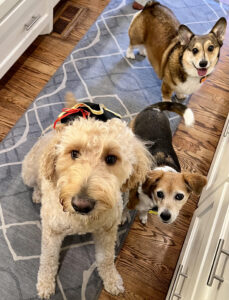
Just like those smart speakers, the dogs are always listening, too. Even during naps, they keep one floppy or pointy ear open for words that are worth waking up for — both the good ones and the scary ones.
At our house, we learned the hard way to never say the word “vet” within earshot of my mom’s rescue mutt, Freckles. If she hears even the whispered spelling, she’ll dive straight under the king-size bed and wriggle to the middle, where it’s harder to reach her and drag her back out.
Almost all dogs get excited over words like “treat,” “outside,” or “walk.” Our stubby-legged Corgi barked so loudly every time I said the word “outside” that I started finding ways around it. I’d come home from errands and ask Tom, “Has he been to the place with grass lately?” (I didn’t want to say the “o-word” if he’d already been there because then he’d insist on going out again just to re-sniff every blade of grass.)
The workaround phrase worked approximately three times before the dog caught on. Instead of keeping him in the dark as I’d hoped, I simply taught him more words without meaning to. We had to add “grass” to the list of words we cannot say or spell without sending the dog sprinting to the back door in a barrage of barks.
In mid-May, our daughter and her 90-pound Goldendoodle service dog, Mac, came home for the summer break. Mac brought his own vocabulary, including favorites like “bone,” “cheese,” and “pool.”
It has been several years since our adult kids have been excited about the annual opening of the backyard pool, but Mac’s thrill-o-meter hits level 100 every time he sees that pool water sparkling in the sun. He bolts straight to the shallow steps, looking back at us to check for permission to bail in.
Last summer, we bought him a pool toy that looks like a realistic, floating fish. When we toss it into the deep end, Mac launches out across the water with his mouth wide open — ready to scoop up the fish and swim it back to shore.
We’re amazed at how smoothly he glides through the water with his wet, blonde curls plastered against his head. He points his nose toward the pool steps as his long legs work silently under the surface. It’s only his tail that sticks up and tilts rhythmically from side to side, like his own built-in rudder. Mac would swim to the point of exhaustion if we let him, so we have to lure him out of the water with the promise of a b-o-n-e, which he gets to gnaw on while one of us blow-dries his hair.
Are your dogs good at spelling, too? I’d love to hear your pet’s most unusual vocabulary words, so send them my way. And as we head into fireworks season over the next week or two, remember to protect your dog’s nervous system. If the booms and bangs are loud to our human ears, we can only imagine how much louder and scarier they are to a dog’s more sensitive ears.
I recommend distracting them with a special t-r-e-a-t and plenty of extra l-o-v-e.
Gwen Rockwood is a syndicated freelance columnist. and novelist Email her at gwenrockwood5@gmail.com. Her new novel is available on Amazon.